Move Your Accounting to the Cloud With Greater Confidence
Assurance360 helps businesses, CPA firms, accounting practices, and finance teams move from existing accounting environments to cloud-based accounting systems through a structured migration approach.
We help you prepare your financial data, establish the new accounting environment, support migration activities, validate the results, and create a stronger foundation for modern finance operations.
Key Benefits
Structured accounting system migration
Support for cloud-based collaboration
Improve access to financial information
Chart of accounts
mapping
Data validation and reconciliation
Support for connected finance systems
Better access to financial information
Organized financial data migration
Assist recurring reporting processes
Reduced migration
disruption
Improved accounting workflow potential
Foundation for future automation
Flexible, Secure, and Accessible
Cloud Accounting Migration is the structured process of moving your accounting environment, financial data, configurations, and relevant processes from an existing system into a cloud-based accounting platform.
Depending on your situation, the migration may involve:
Data preparation
Migration planning
Chart of accounts mapping
Customer and vendor data
Products and services
Opening balances
Tax-related configurations
User access
Accounting preferences
Accounting preferences
Reporting
Reporting
Data validation
Data validation
User transition
Post-migration support
The exact migration scope depends on the source system, destination platform, data structure, business requirements, and migration objectives.
Modernize the Way Your Finance Team Works
Traditional accounting environments can create challenges as businesses grow.
You may experience:
Limited remote access
Manual data transfers
Limited integration options
Multiple versions of financial files
Heavy dependence on spreadsheets
Limited remote access
Difficult collaboration
Difficult system maintenance
Outdated accounting systems
Time-consuming reporting processes
Cloud accounting can provide a more connected environment where authorized users can access financial information and work with accounting systems from supported locations and devices.
But moving to the cloud should be carefully planned.
The objective is not simply to move your accounting system. The objective is to create a better finance environment.
A Structured Approach to Moving Your Finance Environment
Understand Your Existing Accounting Environment
Before migration begins, we review the existing environment and identify the major migration requirements.
Assessment may cover:
Current accounting platform
Data structure
Chart of accounts
Customer records
Vendor records
Financial accounts
Historical data
Reporting & Integrations
Existing workflows
User requirements
Goal
Create a clear understanding of what needs to move, what needs to be reconfigured, and what needs to be reviewed before migration.
Build a Clear Roadmap Before Moving Financial Data
A migration should be planned rather than improvised.
Assurance360 can help establish a migration plan covering:
Migration scope
Data requirements
Account mapping
Migration sequence
Responsibilities
Testing requirements
Validation process
Go-live approach
Migration Planning Framework
CURRENT SYSTEM → ASSESSMENT → MIGRATION SCOPE → DATA PLAN → MAPPING → MIGRATION → VALIDATION → GO-LIVE
Prepare Financial Data Before Migration
The quality of the data being migrated can directly affect the quality of the new accounting environment.
Depending on the migration scope, preparation may include reviewing:
Chart of accounts
Customer records
Vendor records
Products and services
Bank accounts
Financial accounts
Opening balances
Historical transactions
Duplicate records
Inactive records
Data formats
The objective is to prepare information for the destination system based on its structure and capabilities.
Translate Your Existing Accounting Structure Into the New Environment
Your current chart of accounts may not directly match the structure of the new cloud accounting platform.
Mapping may therefore be required.
EXISTING SYSTEM → CURRENT ACCOUNT → ACCOUNT REVIEW → MAPPING → NEW CLOUD ACCOUNT → VALIDATION
A properly structured chart of accounts can support:
Consistent transaction classification
Financial reporting
Account mapping
Management reporting
Reconciliation
Future scalability
Move Your Business Relationships Into the New Environment
Customer and vendor records may be an important part of the migration.
Depending on the platform and scope, migration support may include:
Customer Data
Customer names
Contact information
Billing information
Payment terms
Tax-related information
Other supported fields
Vendor Data
Vendor names
Contact information
Payment information
Payment terms
Tax-related information
Other supported fields
Data mapping and validation are important to maintain consistency.
Move Relevant Accounting Information Into the Cloud Environment
A secure migration process that transfers relevant accounting data into the cloud while maintaining accuracy, organization, accessibility, and data integrity.
Depending on the migration strategy, financial information may include:
Account balances
Opening balances
Accounts receivable
Accounts payable
Bank information
Financial transactions
Revenue information
Expense information
Other supported historical records
Not every migration requires the same level of historical data.
The appropriate approach depends on your reporting needs, source system, destination platform, data quality, and migration objectives.
Decide What Financial History Should Move
One important migration decision is determining how much historical information should be transferred.
Possible approaches may include:
Full Historical Migration
Move supported historical financial information into the new system.
Opening Balance Migration
Move the appropriate opening balances while retaining historical information separately.
Selective Historical Migration
Move a defined period of historical financial information.
Archive Strategy
Retain historical records outside the new accounting environment while establishing the new cloud system for current operations.
The appropriate approach should be determined based on business, reporting, compliance, operational, and platform requirements.
Configure the New Environment for Your Business
Migration should not stop at moving data.
The destination accounting system needs to be configured appropriately.
Depending on the platform, configuration may include
Company settings
Financial periods
Currency
Chart of accounts
Tax settings
Bank accounts
Customers
Vendors
Products and services
Users
Permissions
Invoicing
Expenses & Reporting
Workflows
This creates the foundation for the migrated information.
Prepare Your Team for Cloud Accounting
Cloud accounting can allow multiple authorized users to work within the same financial environment.
Assurance360 can support defined user and access requirements.
Potential users may include:
Business owners
Finance managers
Accountants
Bookkeepers
Accounts payable & receivable staff
Payroll users
External accountants
Management
Access should be based on responsibilities and the controls required by your organization.
Rebuild Important Processes in the New Environment
Moving data is only one part of the transition.
Your existing finance processes may also need to be reviewed.
Potential workflows include:
Invoicing
Expense management
Vendor bills
Approvals
Payments
Reconciliation
Reporting
Document management
Financial reviews
Example
OLD WORKFLOW
Email → Spreadsheet → Manual Entry → Accounting System NEW WORKFLOW Source → Cloud Accounting → Workflow → Review → Accounting → Reporting
The goal is to use the migration as an opportunity to improve appropriate processes rather than simply reproduce inefficient manual workflows.
Who Can Benefit From Cloud Accounting Migration?
Startups
Growing & Smaall Businesses
Accounting Firms
CPA Firms
Businesses Replacing Legacy Systems
Mid-Sized Businesses
Dedicated Finance Support Across Industries
Our dedicated professionals can support businesses across multiple industries.
Technology
E-Commerce
Infrastructure
Healthcare
Manufacturing
Professional Services
Hospitality
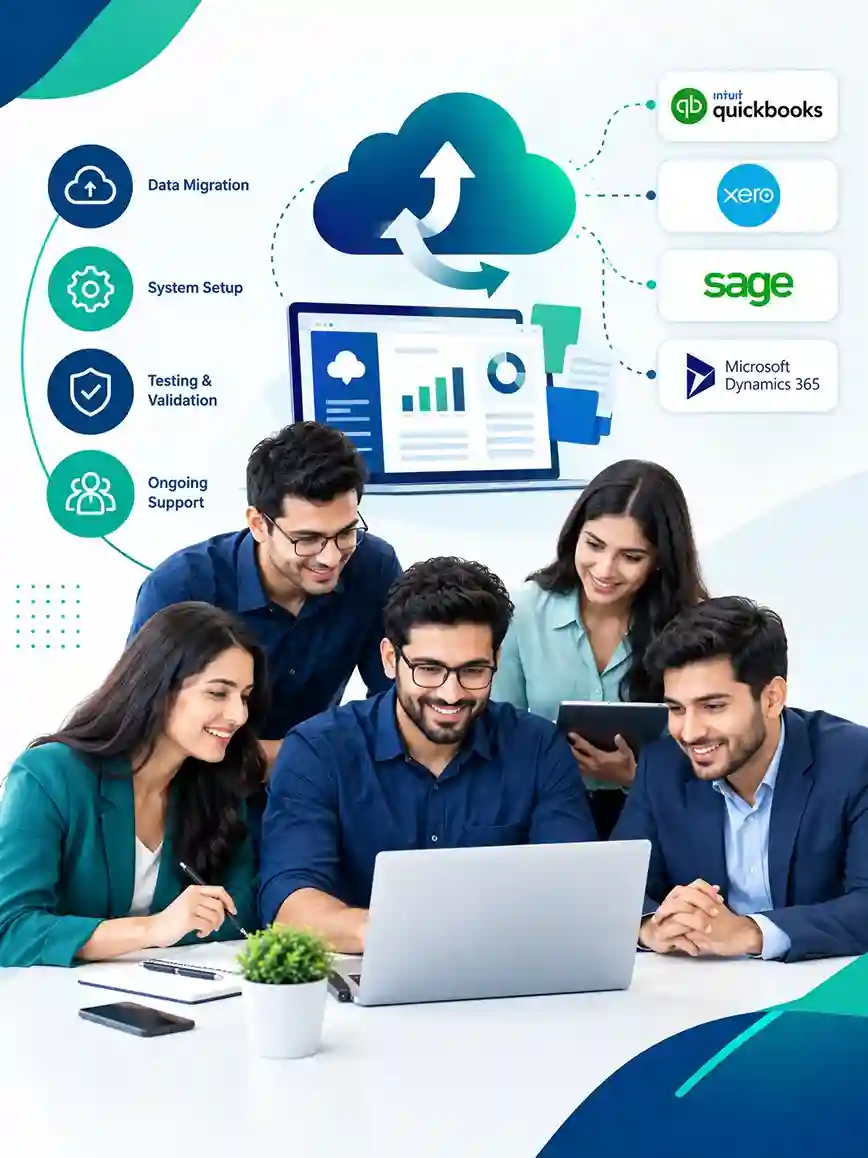
Common Accounting Platforms
Assurance360 can work with your existing financial systems and reporting environment where supported.







From Existing Accounting System to Cloud Finance
A structured migration process that transfers accounting data securely, configures cloud systems, validates information, and prepares your business for efficient financial management.
Validate & Test
Compare key financial information, investigate differences, and test workflows, reporting, access, and relevant integrations.
Go Live & Optimize
Transition the business to the cloud accounting environment, then review performance and identify opportunities for workflow improvement and automation.
Your Success Is Our Priority
Experienced Accounting Professionals
Scalable Solutions
Cost Effective Outsourcing
Data Security & Confidentiality
Real-Time Reporting
Global Service Delivery


0+
Years Experience

0+
Active Clients
Have Any Question?
What is Cloud Accounting Migration?
Cloud Accounting Migration is the process of moving accounting systems, financial data, configurations, and relevant processes from an existing environment to a cloud-based accounting platform.
Why should a business move to cloud accounting?
Cloud accounting can support accessibility, collaboration, integrations, scalability, and modern finance workflows. The actual benefits depend on the platform and how it is implemented.
Can you migrate our existing accounting data?
Assurance360 can support data preparation and migration activities based on the source system, destination platform, available data, and agreed migration scope.
Do we need to migrate all historical data?
Not necessarily. The appropriate historical data strategy depends on reporting requirements, operational needs, data quality, platform capabilities, and other business considerations.
Can you migrate the chart of accounts?
Yes. Chart of accounts mapping can be part of the migration process.
Can you migrate customers and vendors?
Where supported by the destination platform, customer and vendor records can be included within the migration scope.
Can you migrate opening balances?
Yes. Opening balance preparation and validation can be included in an appropriate migration project.
Can you migrate historical transactions?
This depends on the source system, destination platform, available data, and agreed migration strategy.
Will my financial reports remain the same?
Reports may differ between accounting platforms. Assurance360 can help identify the reporting requirements and configure appropriate reporting in the new environment.
Can you connect our accounting system with other applications?
Where technically supported, integrations with banking, payroll, CRM, ERP, payment, expense, reporting, and other systems can be assessed.
Can cloud accounting reduce manual work?
It can create opportunities for improved workflows and automation, although the actual level of automation depends on the platform, process design, and integrations.
Do you support CPA firms?
Yes. Assurance360 can support CPA and accounting firms with defined cloud accounting migration and implementation activities.
Ready to Improve Your Financial Management?
Partner with Assurance360 for professional general accounting services that provide financial clarity, reporting accuracy, and operational efficiency.
Whether you need outsourced accounting support, financial reporting, reconciliations, or a dedicated accounting team, our experts are ready to help.